Executive Summary
The optical storage revolution represents one of the most enduring and continuously evolving chapters in data storage history, from the pioneering Compact Disc in 1982 to the revolutionary 5D optical crystals capable of storing petabits of data for billions of years. While the global recordable optical disc market reached $8.6 billion in 2024 and is projected to grow to $11.73 billion by 2033, the technology faces a fundamental transformation.
Traditional optical media—CDs, DVDs, and Blu-ray discs—continue to serve critical archival and specialized applications despite the digital revolution. However, the market shows declining trends with a CAGR of -1.40% from 2024 to 2034 for traditional formats, while next-generation optical technologies promise storage densities of 1.6 petabits per disc—equivalent to storing 14,285 4K movies on a single DVD-sized disc.
The evolution reveals a stark contrast between legacy and future optical storage:
- Traditional Capacity: CD (700 MB), DVD (8.5 GB), Blu-ray (50 GB)
- Future Potential: 5D optical storage (360 TB), 3D nanoscale discs (1.6 PB), DNA-glass hybrid storage (100 PB+)
- Lifespan: Traditional discs (10-100 years) vs. 5D crystals (13.8 billion years)
- Durability: Surface-based vs. volumetric storage resistant to 1,000°C temperatures

The Optical Storage Paradox
Optical storage technologies face a unique market position: declining in consumer applications while simultaneously experiencing revolutionary breakthroughs in laboratory research that promise to transform archival storage, enterprise backup, and long-term data preservation for centuries to come.
The Evolution of Optical Storage: Technical Foundation
Physical Principles and Laser Technology
Optical storage relies on the fundamental principle of laser light interaction with physical media to encode and retrieve digital information. The technology evolution is directly tied to advances in laser wavelength precision and optical component miniaturization.
Laser Wavelength Progression
| Format | Laser Wavelength | Numerical Aperture | Min Pit Length | Track Pitch | Storage Capacity |
|---|---|---|---|---|---|
| CD | 780 nm (infrared) | 0.45 | 0.83 μm | 1.6 μm | 700 MB |
| DVD | 650 nm (red) | 0.60 | 0.40 μm | 0.74 μm | 8.5 GB |
| Blu-ray | 405 nm (blue-violet) | 0.85 | 0.15 μm | 0.32 μm | 50 GB |
| Future 5D | 800 nm + multiplex | 0.85+ | Nanogratings | 3D volume | 360 TB+ |
The relationship between laser wavelength and storage density follows the diffraction limit principle: smaller wavelengths = tinier data pits = more stuff crammed onto your shiny disc. It's like the difference between writing with a Sharpie versus a mechanical pencil – precision matters when you're trying to fit War and Peace onto something the size of a coaster.
Physical Data Encoding Methods
Traditional Optical Storage: Surface-Based Encoding
Traditional Optical Storage: Surface-Based Encoding
All conventional optical formats use the same basic trick: laser goes "pew," hits a pit (or doesn't), bounces back (or doesn't), and voilà – you've got your 1s and 0s. It's surprisingly elegant for something that looks like it could double as a drink coaster.
The magic happens at exactly λ/4 depth – that's not random engineering, that's physics being clever. When light bounces off a pit that's exactly one-quarter wavelength deep, it interferes destructively with light bouncing off the surface, creating that perfect digital "0." It's like nature's own binary system, except it took us until 1982 to figure it out.
Physical Layer Structure
| Layer | CD | DVD | Blu-ray | Function |
|---|---|---|---|---|
| Protective coating | 1.1 mm polycarbonate | 0.6 mm polycarbonate | 0.1 mm hard coat | Scratch protection |
| Data layer | Aluminum reflective | Aluminum reflective | Silver alloy | Information storage |
| Substrate | 1.2 mm polycarbonate | 1.2 mm (dual layer) | 1.1 mm polycarbonate | Structural support |
| Label layer | Printed/adhesive | Printed/adhesive | Printed/hard coat | Identification |
Format Analysis: Technical Specifications and Evolution
Compact Disc (CD) - The Pioneer Format
Introduction: 1982 (when your parents were young and thought CDs were witchcraft)
Theoretical Foundation: Phillips and Sony decided to revolutionize music by making it skip-proof... mostly.
The CD Revolution: Remember when you could scratch a vinyl record by breathing on it wrong? CDs promised indestructibility – until everyone discovered that peanut butter fingerprints were their kryptonite.

Technical Specifications That Actually Matter:
- Storage capacity: 650-700 MB (which seemed infinite in 1982)
- Laser wavelength: 780 nm (infrared, so you can't see the magic happening)
- Track format: One continuous spiral that's 5.77 km long (uncoiled, it could stretch across a small town)
- Fun fact: The 74-minute duration was chosen to fit Beethoven's 9th Symphony. Classical music literally shaped the digital age.
CD Format Variants:
| Format | Capacity | Use Case | Write Method | Lifespan |
|---|---|---|---|---|
| CD-ROM | 650-700 MB | Software distribution | Mass replication | 20-50 years |
| CD-R | 650-700 MB | Write-once storage | Dye layer burning | 10-50 years |
| CD-RW | 650-700 MB | Rewritable storage | Phase-change alloy | 10-25 years |
| Mini CD | 185-210 MB | Portable applications | Same as full size | Similar to full CD |
Digital Versatile Disc (DVD) - The Multimedia Revolution
Introduction: 1997 (when "Digital Versatile Disc" was peak '90s marketing speak)
Key Innovation: "What if we made the laser redder and the pits smaller?" – Genius level engineering
DVDs were the game-changer that made us all throw out our VHS collections faster than we'd later abandon our DVD collections for Netflix. Suddenly, movies came with "special features" (aka deleted scenes that were deleted for good reasons) and multiple language tracks (so you could finally watch Jackie Chan movies in Mandarin like they were meant to be seen).
Why DVDs Conquered the World:
- Perfect timing: Just as internet was too slow for video
- Better quality: No more rewinding, no more tape getting eaten
- Bonus content: Director's commentary became a thing
- Durability: Could survive a toddler... sometimes
DVD Format Evolution:
| Format | Layers | Capacity | Applications | Market Status |
|---|---|---|---|---|
| DVD-5 | Single layer, single side | 4.7 GB | Standard movies, software | Dominant |
| DVD-9 | Dual layer, single side | 8.5 GB | Long movies, games | Common |
| DVD-10 | Single layer, dual side | 9.4 GB | Special applications | Rare |
| DVD-18 | Dual layer, dual side | 17.1 GB | Extended content | Very rare |
Blu-ray Disc - High Definition Era
Introduction: 2006 (just in time for the HD-DVD format war that nobody asked for)
Revolutionary Advance: Blue-violet lasers, because apparently regular blue wasn't fancy enough
The Blu-ray vs. HD-DVD war was like watching two bald men fight over a comb – by the time Sony won, most people were already streaming potato-quality videos on YouTube and loving it. But damn, when Blu-ray worked, it was beautiful.
The Technical Marvel:
- 405 nm blue-violet laser: So precise it makes a surgeon jealous
- 25-50 GB capacity: Enough for a full movie in 1080p without wanting to cry
- 0.1 mm cover layer: Thinner protection = better laser focus = more scratches (thanks, physics)
Fun Fact: The "e" was intentionally dropped from "Blue-ray" because you can't trademark common words. Marketing genius or spelling error? You decide.
Blu-ray Format Variants:
| Format | Capacity | Layers | Target Use | Adoption Level |
|---|---|---|---|---|
| BD-25 | 25 GB | Single | HD movies, games | Standard |
| BD-50 | 50 GB | Dual | Extended HD content | Common |
| BD-XL 100 | 100 GB | Triple | 4K content, archival | Professional |
| BD-XL 128 | 128 GB | Quad | Ultra HD, data backup | Specialized |
Market Dynamics and Decline Factors
Global Market Analysis
The optical disc market presents a complex picture of decline in consumer segments offset by growth in specialized applications:
Market Size Trends:
- Global recordable optical disc market: $8.6 billion (2024) → $11.73 billion (2033)
- Overall market CAGR: 3.2% growth
- Traditional formats declining at -1.40% CAGR
Regional Market Performance
| Region | Market Position | Growth Rate | Key Drivers | Challenges |
|---|---|---|---|---|
| North America | 35% market share | -2.40% CAGR | Professional archival, compliance | Digital streaming dominance |
| Europe | 28% market share | -2.00% CAGR | Data protection regulations | Cloud storage adoption |
| Asia Pacific | 23% market share | -3.00% CAGR | Manufacturing, healthcare | Mobile-first consumption |
| Rest of World | 14% market share | Variable | Emerging market adoption | Infrastructure limitations |
Factors Contributing to Market Decline
1. Digital Distribution Revolution
The streaming apocalypse happened faster than anyone expected. One day we're buying DVDs, the next day we're arguing with Netflix about why our favorite show disappeared.
What Killed the Optical Star:
- Netflix: "Why drive to Blockbuster when you can wait 2 days for mail?"
- Spotify: "Why own music when you can rent it forever?"
- Steam: "Why have game boxes when you can have a library that disappears when servers die?"
- YouTube: "Why buy movies when you can watch cats for free?"
2. The Convenience Apocalypse
Modern humans will trade ownership for convenience faster than you can say "subscription model." We went from "I own this forever" to "I pay $15/month to maybe access this sometimes" and somehow convinced ourselves it was progress.
| Factor | Optical Discs | Digital Alternatives | Consumer Preference |
|---|---|---|---|
| Access Speed | Insert disc, load | Instant streaming/download | Digital wins |
| Storage Space | Physical shelf space | No physical storage needed | Digital wins |
| Portability | Carry individual discs | Access from any device | Digital wins |
| Sharing | Lend physical disc | Multiple user accounts | Mixed |
| Permanence | Permanent ownership | Subscription dependent | Optical wins |
| Quality | Uncompressed content | Variable compression | Optical wins |
Surviving Market Segments
Despite overall decline, specific sectors maintain strong optical disc demand:
1. Professional Archival and Compliance
Healthcare Industry:
- Medical imaging archives requiring long-term storage
- HIPAA compliance mandating physical backup options
- 100+ year retention requirements for certain medical records
Government and Legal:
- Legal document archival with authenticity requirements
- National archives and historical preservation
- Air-gapped security for classified information
2. Entertainment Industry Production
Professional Media Production:
- 4K Ultra HD Blu-ray for premium home theater experiences
- Master archival copies for film and television
- High-fidelity audio production masters
3. Gaming Industry
Console Gaming:
- PlayStation 5 and Xbox Series X continue disc support
- Collectors' editions and special releases
- Offline gaming in areas with limited internet
SSD and Flash Memory Limitations as Archival Solutions
Understanding NAND Flash Degradation
SSDs are like that friend who's super fast and helpful but burns out after a few years of hard living. They're built on NAND flash memory, which is basically millions of tiny electrical prisons for electrons. Every time you write data, you're essentially breaking down the prison walls a little bit. Eventually, the walls crumble, and your data escapes into the digital void.
The Temperature Problem (Why Your Data Melts)
Here's the kicker: SSDs hate heat more than a vampire hates sunlight. For every 10°C temperature increase, data retention time roughly halves. So that SSD you stored in your garage? Your data is probably already planning its escape.
The Heat Death Timeline:
- 30°C: "I'm fine, thanks for asking"
- 40°C: "Starting to feel a bit wobbly"
- 50°C: "Help, my electrons are having an existential crisis"
- 60°C: "Data? What data? I don't know her."
| NAND Type | P/E Cycles | Typical Lifespan | Data Retention (Powered) | Data Retention (Unpowered) |
|---|---|---|---|---|
| SLC | 50,000-100,000 | 10+ years | 10 years | 10+ years |
| MLC | 3,000-10,000 | 5-7 years | 5-7 years | 2-5 years |
| TLC | 500-3,000 | 3-5 years | 3-5 years | 1-3 years |
| QLC | 100-1,000 | 1-3 years | 1-3 years | Months to 1 year |
Temperature-Dependent Data Retention
SSD data retention is critically dependent on storage temperature:
class SSDataRetention:
    def __init__(self):
        self.retention_factors = {
            'temperature_impact': {
                '30C': 'Baseline retention period',
                '40C': '50% reduction in retention time',
                '50C': '75% reduction in retention time',
                '60C': '87.5% reduction in retention time'
            },
            'jedec_standards': {
                'consumer_ssd': '1 year at 30°C after endurance limit',
                'enterprise_ssd': '3 months at 40°C after endurance limit'
            }
        }

    def calculate_retention_degradation(self, base_temp, storage_temp):
        """
        For every 10°C increase, retention time roughly halves
        """
        temp_diff = storage_temp - base_temp
        degradation_factor = 2 ** (temp_diff / 10)
        return f"Retention reduced by factor of {degradation_factor}"
Fundamental Physical Limitations
1. Charge Leakage in Floating Gate Technology
NAND flash stores data as electrical charge in insulated floating gates. This charge inevitably leaks over time:
- Mechanism: Fowler-Nordheim tunneling allows electrons to escape through oxide barriers
- Acceleration factors: Temperature, previous write cycles, manufacturing quality
- Irreversible degradation: Each P/E cycle slightly damages the oxide layer
2. Write Amplification Effects
SSDs cannot simply overwrite data; they must erase entire blocks before writing:
class WriteAmplificationExample:
    def update_small_file(self, original_data, new_data):
        """
        Demonstrates why SSDs have limited archival utility
        """
        # Can't overwrite in place - must erase and rewrite entire block
        steps = [
            "1. Read entire 256KB block containing small file",
            "2. Erase entire 256KB block (P/E cycle consumed)",
            "3. Write updated data + all other block data",
            "4. Original small file update becomes large block rewrite"
        ]

        write_amplification = "256KB block write for 4KB file update = 64x amplification"
        return write_amplification
Comparison: Optical vs. Flash Archival Properties
| Property | Optical Discs | SSDs/Flash | Advantage |
|---|---|---|---|
| Data retention (unpowered) | 10-100+ years | Months to 10 years | Optical |
| Temperature sensitivity | Minimal (up to 70°C) | Critical (halves every 10°C) | Optical |
| Physical durability | Scratch-sensitive surface | Internal component failure | Mixed |
| Bit rot resistance | Excellent (physical pits) | Poor (charge leakage) | Optical |
| Write endurance | Write-once (R) or limited (RW) | Limited P/E cycles | Optical |
| Access speed | Slow (100-200 MB/s) | Fast (500-7000 MB/s) | Flash |
| Random access | Slow seek times | Excellent | Flash |
| Power requirements | None for storage | Required for data retention | Optical |
| Cost per GB (archival) | $0.05-0.20 | $0.10-1.00 | Optical |
The Future of Optical Storage: Revolutionary Technologies
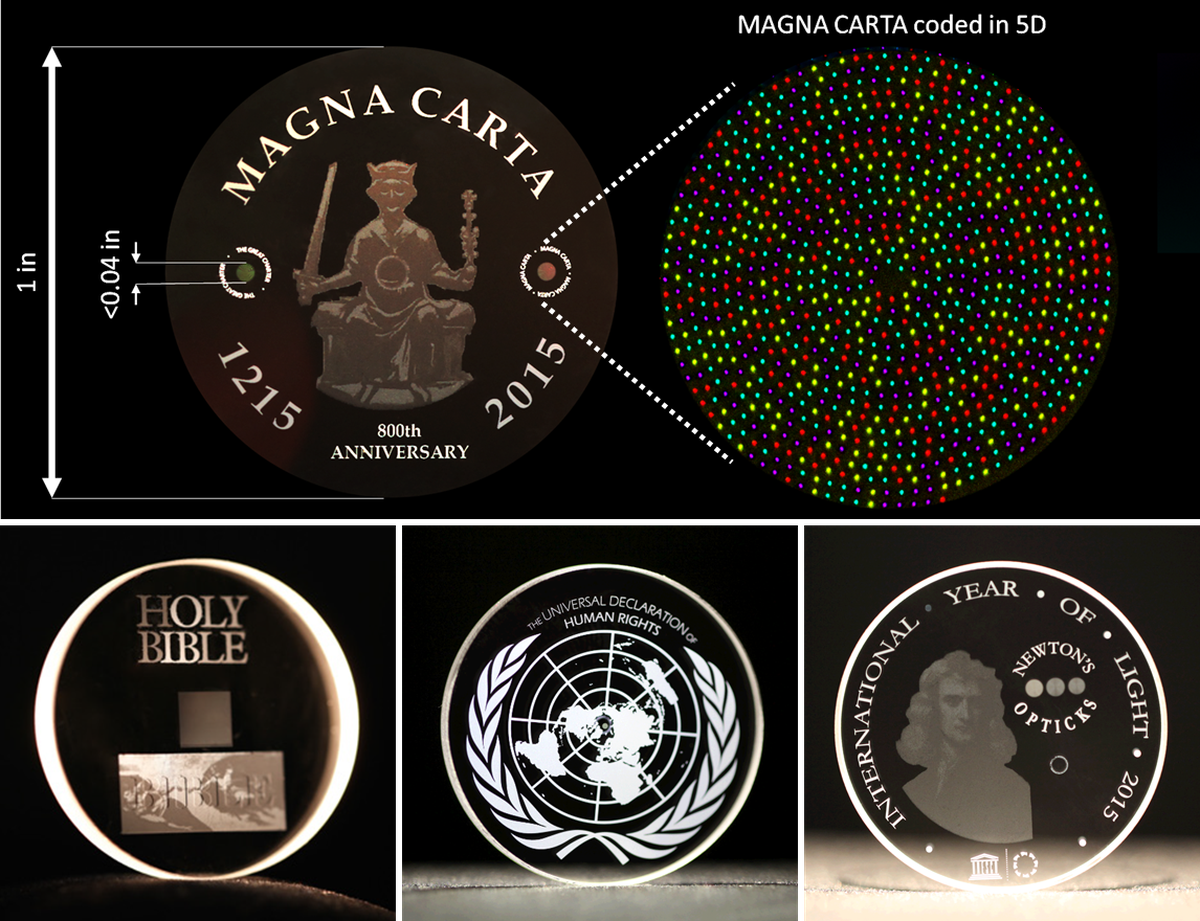
5D Optical Data Storage - "Superman Memory Crystals"
Scientists at the University of Southampton looked at regular optical storage and said, "You know what this needs? MORE DIMENSIONS." And thus, 5D optical storage was born – because apparently 3D wasn't showing off enough.
What Makes It "5D": It's not actually storing data in five spatial dimensions (that would break physics and probably the universe). Instead, it uses five properties of light to encode information:
- Where the nanostructure is (X, Y, Z coordinates)
- How it's oriented (polarization angle)
- What size it is (because size matters in nanoscale engineering)
The Ridiculous Durability: These crystals can survive 1,000°C temperatures and last 13.8 billion years. That's longer than the current age of the universe. Your descendants' descendants' descendants will still be able to read your meme collection.
Real-World Applications (That Actually Happened)
- 2018: Isaac Asimov's Foundation trilogy was stored on a 5D crystal and launched into space with Elon Musk's Tesla Roadster. Because apparently, aliens need good sci-fi too.
- 2024: The entire human genome was encoded on a coin-sized disc with a visual key explaining how to use it, like a cosmic instruction manual for rebuilding humanity.
Unprecedented Durability
5D optical storage offers unprecedented longevity:
Durability Specifications:
- Lifespan: 13.8 billion years at room temperature
- Temperature resistance: Stable up to 1,000°C
- Physical impact: Withstands direct impact of half a ton
- Environmental resistance: Immune to electromagnetic interference, radiation
3D Nanoscale Optical Discs
Recent breakthroughs from Shanghai University demonstrate 1.6 petabit capacity using 3D nanoscale writing techniques:
Technical Achievement:
- Capacity: 1.6 petabits (200,000 GB)
- Equivalent storage: 14,285 4K movies of 14 GB each
- Density improvement: 4,000 times denser than Blu-ray
- Layer count: 100 active layers vs. 2-4 in traditional optical media
AIE-DDPR Technology
The breakthrough uses "dye-doped photoresist with aggregation-induced emission luminogens":
| Property | Traditional Optical | AIE-DDPR 3D | Improvement Factor |
|---|---|---|---|
| Storage layers | 1-4 | 100+ | 25x-100x |
| Areal density | 25 GB/layer (BD) | 16 TB/layer | 640x |
| Total capacity | 50 GB (BD) | 1.6 PB | 32,000x |
| Data stability | 10-100 years | 1000+ years projected | 10x+ |
| Write resolution | 150 nm (BD) | Sub-50 nm | 3x+ |
Microsoft Project Silica
Microsoft's Project Silica represents enterprise-focused glass storage:
Technical Specifications:
- Medium: Fused silica glass plates
- Capacity: 7 TB per 120mm × 120mm × 2mm plate
- Writing method: Femtosecond laser pulses creating voxel modifications
- Durability: Resistant to electromagnetic interference, extreme temperatures
- Target market: Enterprise archival storage and data centers
Advanced Future Storage Technologies
Holographic Data Storage
Holographic storage uses laser interference patterns to store data in three dimensions:
Technical Principle:
- Data encoding: Interference patterns between signal and reference beams
- 3D storage: Data distributed throughout the volume of the medium
- Massive parallelism: Entire pages of data read simultaneously
- Capacity potential: Terabytes in sugar-cube-sized volumes
DNA Data Storage Integration
Meanwhile, some absolute madlads in labs around the world decided that if nature could store the instructions for building every living thing in DNA, maybe we could store our Netflix queue there too.
DNA Storage Reality Check:
- Capacity: 215 petabytes per gram (that's every movie ever made in a sugar packet)
- Speed: Currently slower than dial-up internet from 1995
- Cost: $100,000 per gigabyte (your music collection would cost more than a house)
- Durability: Works after 300,000 years (outlasts all your ex-relationships combined)
The Irony: We're literally storing digital cat videos in the same molecule that stores the instructions for making actual cats. Evolution is having a laugh.
Market Transformation Timeline
Near-term Evolution (2025-2030)
Traditional Optical Market:
- Continued decline in consumer applications (-2% to -5% CAGR)
- Growth in specialized archival applications (+5% to +10% CAGR)
- Blu-ray maintaining position in premium home theater
Emerging Technology Readiness:
- 5D optical storage: Laboratory to pilot commercial deployment
- Microsoft Silica: Enterprise data center trials
- 3D nanoscale discs: Research to development phase
Medium-term Transformation (2030-2040)
Market Disruption Scenarios:
| Technology | Commercialization Timeline | Target Market | Capacity Range | Cost Projection |
|---|---|---|---|---|
| 5D Optical Storage | 2028-2032 | Enterprise archival | 100 TB - 1 PB | $10-100/TB |
| 3D Nanoscale Discs | 2030-2035 | Mass storage | 1-10 PB | $1-10/TB |
| DNA-Glass Hybrid | 2035-2040 | Ultra-long-term archival | 100 PB+ | $0.10-1/TB |
| Holographic Storage | 2032-2038 | High-speed archival | 10-100 TB | $5-50/TB |
Long-term Vision (2040-2060)
Technological Convergence: The future points toward convergence of multiple advanced storage technologies:
- Hierarchical Storage Systems: Fast optical access to DNA-encoded archives
- Quantum-Enhanced Reading: Quantum sensors for ultra-sensitive data retrieval
- Molecular-Scale Engineering: Atomic-precision data encoding
- Universal Format Standards: Cross-technology compatibility protocols
Industry Applications and Use Cases
Professional Archival Applications
1. Cultural Heritage Preservation
Digital Archives:
- National libraries digitizing centuries of documents
- 5D optical storage used for Foundation trilogy space archive
- Human genome encoded on coin-sized 5D disc in 2024
2. Scientific Data Preservation
Long-term Research Archives:
- Climate data requiring century-scale storage
- Astronomical observations and space mission data
- Medical research datasets for longitudinal studies
3. Legal and Compliance
Regulatory Requirements:
- Financial institutions: 7+ year record retention
- Healthcare: Lifetime patient record storage
- Government: Classified document preservation
Enterprise Storage Strategies
Hybrid Optical-Electronic Systems
Modern enterprise storage increasingly adopts tiered approaches combining multiple technologies:
class TieredStorageArchitecture:
    def __init__(self):
        self.storage_tiers = {
            'tier_0_hot': {
                'technology': 'NVMe SSD',
                'capacity': '10-100 TB',
                'access_time': '<1ms',
                'use_case': 'Active databases, OS, applications'
            },
            'tier_1_warm': {
                'technology': 'SATA SSD / High-speed HDD',
                'capacity': '100-1000 TB',
                'access_time': '1-10ms',
                'use_case': 'Recent files, backup staging'
            },
            'tier_2_cold': {
                'technology': 'Optical disc arrays',
                'capacity': '1-10 PB',
                'access_time': '10-60 seconds',
                'use_case': 'Compliance archives, historical data'
            },
            'tier_3_frozen': {
                'technology': '5D optical / DNA storage',
                'capacity': '10-1000 PB',
                'access_time': '1-60 minutes',
                'use_case': 'Long-term preservation, disaster recovery'
            }
        }

    def calculate_cost_efficiency(self):
        return {
            'tier_0': '$2-10/GB - highest performance',
            'tier_1': '$0.20-2/GB - balanced performance',
            'tier_2': '$0.05-0.50/GB - cost-effective archival',
            'tier_3': '$0.001-0.10/GB - ultra-long-term storage'
        }
Enterprise Optical Deployment Models

1. Automated Optical Libraries:
- Robotic disc changers with 1000+ disc capacity
- Integration with enterprise backup software
- Compliance with regulations like SOX, HIPAA, GDPR
2. Cloud-Integrated Optical Storage:
- Hybrid cloud with optical backup tiers
- Automated data lifecycle management
- Geographic distribution for disaster recovery
Environmental and Sustainability Considerations
Energy Efficiency Comparison
Optical storage offers significant environmental advantages for long-term archival:
| Storage Type | Active Power (Watts) | Idle Power (Watts) | Lifespan (Years) | Total Energy Cost |
|---|---|---|---|---|
| HDD Array (10TB) | 200-400 | 100-200 | 3-5 | Very High |
| SSD Array (10TB) | 50-150 | 20-50 | 5-10 | High |
| Optical Library (10TB) | 50-100 | 5-20 | 20-50 | Medium |
| 5D Optical (10TB) | 0 | 0 | 1,000,000,000+ | Minimal |
| DNA Storage (10TB) | 0 | 0 | 100,000+ | Minimal |
Carbon Footprint Analysis
Data Center Environmental Impact:
- Current data centers consume 200 TWh annually
- Traditional storage requires continuous cooling and power
- Optical archives: Write-once, read-many with minimal power
class EnvironmentalImpactCalculator:
    def __init__(self):
        self.storage_footprints = {
            'traditional_datacenter': {
                'power_usage': '200 TWh/year globally',
                'cooling_overhead': '40% additional power',
                'carbon_equivalent': 'Argentina-level emissions'
            },
            'optical_archival': {
                'write_energy': 'One-time laser writing',
                'storage_energy': 'Zero ongoing power',
                'read_energy': 'Minimal laser activation'
            }
        }

    def project_2030_impact(self):
        data_growth = "175 zettabytes by 2025, 1000+ ZB by 2030"
        traditional_scaling = "5x increase in data center power"
        optical_alternative = "99%+ reduction in archival storage power"
        return {
            'traditional_path': 'Unsustainable energy growth',
            'optical_path': 'Sustainable archival storage'
        }
Technical Challenges and Research Frontiers
Current 5D Optical Storage Limitations
Despite revolutionary potential, several technical challenges remain:
1. Write Speed Limitations
Current Performance:
- Writing speed: 3 MB/s for current systems
- 96 TB per year theoretical throughput
- Time to fill 100 PB: 1,000 years at current speeds
Research Solutions:
- Parallel laser writing arrays
- Improved femtosecond laser efficiency
- Advanced focusing optics for simultaneous multi-layer writing
2. Reading Infrastructure
Technical Requirements:
- Specialized optical microscopy equipment
- Polarization-sensitive detection systems
- Complex signal processing for 5D data extraction
Cost Implications:
- Reader systems currently cost $50K-500K
- Specialized training required for operation
- Limited availability of compatible equipment
Manufacturing and Standardization Challenges
Industry Standardization Needs
class OpticalStorageStandardization:
    def __init__(self):
        self.standardization_gaps = {
            'physical_formats': {
                'traditional': 'Well-established (ISO 9660, UDF)',
                '5d_optical': 'No industry standards yet',
                'compatibility': 'Each research group uses proprietary formats'
            },
            'error_correction': {
                'traditional': 'Reed-Solomon, LDPC codes',
                '5d_optical': 'Research-stage algorithms',
                'challenge': 'Multi-dimensional error patterns'
            },
            'manufacturing': {
                'traditional': 'Mature injection molding, sputtering',
                '5d_optical': 'Precision femtosecond laser facilities',
                'cost_barrier': 'Specialized equipment required'
            }
        }

    def project_standardization_timeline(self):
        return {
            '2025-2027': 'Research consortium formation',
            '2028-2030': 'Draft technical specifications',
            '2031-2033': 'Industry standard ratification',
            '2034-2040': 'Commercial ecosystem maturity'
        }
Competitive Technology Analysis
Optical Storage vs. Emerging Alternatives
1. Comparison with DNA Storage
| Factor | 5D Optical Storage | DNA Storage | Winner |
|---|---|---|---|
| Capacity density | 360 TB/disc | 215 PB/gram | DNA |
| Durability | 13.8 billion years | 300,000+ years proven | Optical |
| Write speed | 3 MB/s | 0.001 MB/s | Optical |
| Read speed | Variable | Days to weeks | Optical |
| Random access | Excellent | Poor (sequential) | Optical |
| Cost (projected) | $10-100/TB | $1-10/TB | DNA |
| Technology maturity | Research/early commercial | Research phase | Optical |
| Environmental stability | Extreme conditions | Requires controlled environment | Optical |
2. Holographic Storage Comparison
Holographic Storage Advantages:
- Fast parallel data access (entire pages simultaneously)
- Good random access characteristics
- Mature research foundation
5D Optical Advantages:
- Higher density potential
- Better long-term stability
- More resistant to environmental factors
3. Quantum Storage Technologies
Emerging quantum storage approaches offer theoretical advantages:
class QuantumStorageTechnologies:
    def __init__(self):
        self.quantum_approaches = {
            'atomic_scale_storage': {
                'capacity': '1000x better than current HDDs',
                'mechanism': 'Individual atom manipulation',
                'timeline': '2040-2060',
                'challenges': 'Requires quantum-level control'
            },
            'quantum_state_storage': {
                'capacity': 'Unlimited (theoretical)',
                'mechanism': 'Quantum superposition states',
                'timeline': '2050+',
                'challenges': 'Decoherence, error correction'
            },
            'photonic_quantum_memory': {
                'capacity': 'High density',
                'mechanism': 'Trapped photon states',
                'timeline': '2030-2050',
                'challenges': 'Maintaining coherence'
            }
        }
Economic Impact and Business Models
Market Transformation Economics
Investment Requirements for Technology Transition
Research and Development Costs:
- 5D optical storage R&D: $500M-2B globally
- Manufacturing infrastructure: $5-20B for global scale
- Standardization and ecosystem: $1-5B industry investment
Market Opportunity Analysis:
| Application Sector | Market Size (2030) | Growth Rate | Optical Storage Potential |
|---|---|---|---|
| Enterprise Archival | $50-100B | 15-25% | High - compliance driven |
| Cloud Storage Backup | $100-200B | 20-30% | Medium - cost competitive |
| Cultural Preservation | $5-10B | 10-15% | Very High - longevity critical |
| Scientific Data | $20-50B | 25-35% | High - long-term value |
| Consumer Archival | $10-30B | 5-15% | Low - convenience preferred |
Business Model Evolution
Traditional Optical Business Models:
- Hardware sales: Drives, media manufacturing
- Licensing: Technology patents and standards
- Services: Duplication, archival services
Future 5D Optical Business Models:
- Storage-as-a-Service: Cloud providers offering optical archival tiers
- Compliance solutions: Regulatory archival packages
- Cultural preservation: Government and institutional contracts
- Disaster recovery: Ultra-long-term backup services
Global Research and Development Landscape
Leading Research Institutions
Academic Centers of Excellence
University of Southampton (UK):
- Pioneer in 5D optical storage
- Professor Peter Kazansky's team
- Isaac Asimov Foundation trilogy stored in space
Shanghai University for Science and Technology (China):
- 3D nanoscale optical disc breakthrough
- 1.6 petabit capacity demonstration
- AIE-DDPR material development
Swinburne University of Technology (Australia):
Corporate Research Programs
Microsoft Research:
- Project Silica glass storage
- Enterprise archival focus
- Data center integration research
International Collaboration:
- DNA Data Storage Alliance: Industry consortium for molecular storage
- IARPA MIST Program: US government funding for 1 TB/$1GB DNA storage by 2025
Future Market Predictions and Timeline
Technology Maturity Roadmap
Phase 1: Research to Pilot (2025-2030)
Key Milestones:
- 5D optical storage pilot commercial deployments
- First enterprise 3D nanoscale disc systems
- Standardization of next-generation optical formats
- Manufacturing cost reduction through automation
Market Indicators:
- Traditional optical disc market decline continues at -1% to -3% CAGR
- Specialty archival applications maintain +5% to +10% growth
- Research funding increases 50-100% annually
Phase 2: Commercial Deployment (2030-2040)
Technology Breakthroughs Expected:
- 5D optical storage: $10-100/TB cost targets achieved
- Write speeds improved 100-1000x through parallel processing
- Reader infrastructure costs reduced 90%+
- Integration with cloud storage platforms
Market Transformation:
- Traditional optical discs become niche specialty products
- 5D optical captures 20-50% of archival storage market
- New applications emerge in space storage, extreme environment data
Phase 3: Market Maturity (2040-2060)
Long-term Vision:
- Multi-technology storage ecosystems standard
- DNA-optical hybrid systems commercial deployment
- Quantum-enhanced reading technologies
- Geological-timescale data preservation infrastructure
Economic Impact Projections
class OpticalStorageMarketProjection:
    def __init__(self):
        self.market_scenarios = {
            'conservative': {
                '2030': '$20B total optical storage market',
                '2040': '$100B including next-gen optical',
                '2050': '$500B multi-technology archival market'
            },
            'optimistic': {
                '2030': '$50B with rapid 5D adoption',
                '2040': '$500B market transformation',
                '2050': '$2T global archival technology sector'
            },
            'breakthrough': {
                '2030': '$100B if DNA-optical hybrid succeeds',
                '2040': '$1T market disruption',
                '2050': '$10T information preservation economy'
            }
        }

    def calculate_job_impact(self):
        return {
            'manufacturing': '500K-2M new jobs in advanced optical manufacturing',
            'research': '50K-200K R&D positions in photonics and materials',
            'services': '1M-5M jobs in data archival and management',
            'transition': '2M-10M workers retraining from legacy to advanced systems'
        }
Regulatory and Standards Framework
International Standards Development
Current Standards Bodies
ISO/IEC Joint Technical Committee 1:
- Responsible for optical disc standards (ISO 9660, UDF)
- Developing frameworks for next-generation optical storage
- International cooperation on compatibility standards
ECMA International:
- Historical role in CD/DVD/Blu-ray standards
- Potential role in 5D optical standardization
- Industry liaison for commercial adoption
Emerging Regulatory Considerations
Data Preservation Mandates:
- European GDPR: Right to data portability and long-term access
- US government: Records management modernization
- Cultural heritage: UNESCO digital preservation guidelines
Environmental Regulations:
- Carbon footprint reporting for data centers
- E-waste reduction mandates
- Sustainable technology preferences in government procurement
Conclusion: The Optical Storage Renaissance
The Plot Twist Nobody Saw Coming
Here's the beautiful irony: just when everyone thought optical storage was dead and buried, scientists went and made it immortal. We went from "CDs are outdated" to "let's store human civilization in crystals that will outlast the sun."
Why This Matters (Beyond the Cool Factor)
We're drowning in data. By 2025, we'll create 175 zettabytes annually – that's like creating a new Library of Alexandria every few minutes. Current storage solutions are like trying to hold back the ocean with a colander.
The Storage Reality Check:
- SSDs: Fast but die young, like rock stars
- HDDs: Reliable but mechanical (moving parts = eventual failure)
- Cloud storage: Great until the company goes bankrupt or decides your data isn't profitable
- Optical storage: The cockroach of storage media – it just won't die
The Future is Hilariously Over-Engineered
We're moving toward a world where:
- Your family photos will be encoded in synthetic DNA
- Your backup strategy involves femtosecond lasers and nanoscale engineering
- The instruction manual for rebuilding human civilization fits on a disc the size of a coin
- Future archaeologists will need quantum microscopes to read our grocery lists
The Ultimate Irony: We started with optical storage (CDs) that seemed magical but fragile. We're ending with optical storage (5D crystals) that's literally indestructible. It's like coming full circle, except this time we're using actual wizardry.
The future of human knowledge preservation lies not in the ephemeral clouds of today's internet, but in the enduring light captured within crystalline substrates that will outlast stars themselves.
And yes, that includes your embarrassing tweets from 2015. Disc Market Forecast - Decline trends and specialty growth
- Industry ARC: Recordable Optical Disc Analysis - Blu-ray and 4K market dynamics
- Global Growth Insights: Optical Disc Drive Market - Hardware market analysis
Revolutionary Storage Research
- Digital Trends: Petabit Optical Disc Breakthrough - 1.6 petabit 3D nanoscale storage
- Live Science: New Petabit-Scale Optical Disc - AIE-DDPR technology
- TechTarget: 5D Data Storage Future - Enterprise applications and durability
- Technology Magazine: Microsoft Project Silica - Glass storage commercialization
SSD and Flash Memory Limitations
- DriveSavers: NAND Flash SSD Lifespan - P/E cycle limitations and degradation
- StoredBits: SSD Data Retention Analysis - Temperature-dependent data loss
- Embedded Computing: 5 NAND Flash Myths - Technical limitations explained
- Electronic Design: Flash Memory Endurance - P/E cycle degradation mechanisms
DNA and Future Storage Technologies
- ACS Nano: DNA Data Storage Approaches - Comprehensive DNA storage review
- National Academies: Future Data Storage Technologies - IARPA and government research programs
- TechRadar Pro: DNA Storage Mainstream Potential - Commercial DNA storage devices
- SNIA: DNA Future of Archival Storage - Industry perspective on molecular storage
Technical Specifications and Standards
- CyberLink: Blu-ray Disc Specifications - Detailed technical specifications
- IASA: Optical Disc Media Guidelines - Professional archival standards
- Metropolia: CD/DVD/Blu-ray Technical Comparison - Educational technical analysis
- ResearchGate: Optical Data Pit Dimensions - Physical specifications comparison
The future of human knowledge preservation lies not in the ephemeral clouds of today's internet, but in the enduring light captured within crystalline substrates that will outlast stars themselves.